

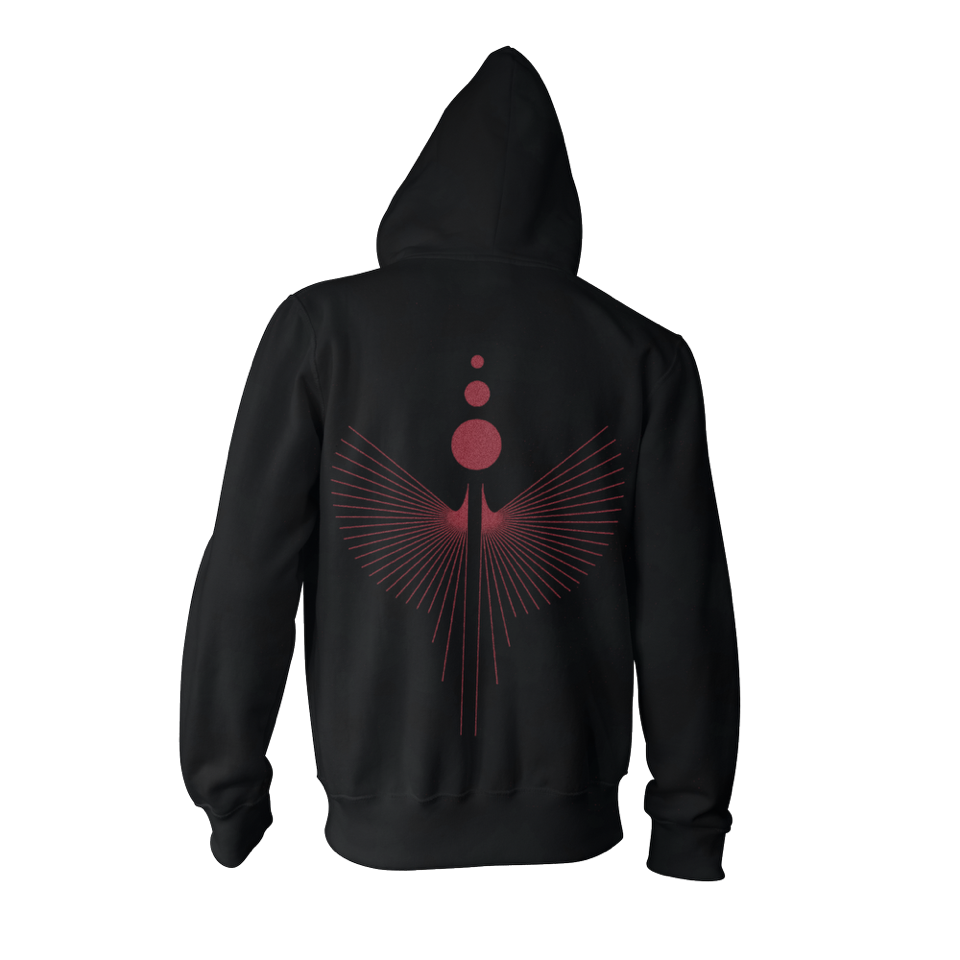
THE OCEAN // SOLARIS ZIPPER JUMPER
THE OCEAN // SOLARIS ZIPPER JUMPER
Release Date: 25th September, 2026
The end of The Ocean’s 2023 album Holocene concludes with a bleak vision of a dystopian landscape on Earth, depleted and uninhabitable. The only option to ensure survival is a drastic course of action; one that signals a new era: the creation of new, artificial worlds with living conditions resembling those on Earth. Human intelligence forms the foundation of technological progress; yet it is precisely this progress that inevitably leads to self-destruction. As rational beings, we are fundamentally just as capable of initiating our own extinction as we are of preventing it.
Since the release of Holocene, The Ocean itself has gone through radical changes, and the arrival of a new album in the shape of Solaris signals the beginning of a new era for the band.
Solaris introduces new vocalists Lane Shi and Enrico Tiberi, as well as guitarists Emmanuel Jessua and Marco Gennaro, who join founding guitarist Robin Staps, longtime bassist Mattias Hägerstrand, and drummer Jordi Farré. Each contributes their own unique flair to bring to life the near-70 minute opus that marks a new high point for The Ocean in terms of ambition and narrative scope.
As the Holocene-era lineup collapsed in the wake of heavy touring, shifting life priorities and band members moving away to other countries, Staps contemplated the future of the band he had dedicated almost 25 years of his life to. The way forward became clear through a series of chance encounters and existing connections: one by one, pieces of the new band formation fell into place, and when the old lineup played their last show at Hellfest 2025, he found himself already in the middle of working on a new album. Existing instrumental compositions gained a new impetus under the gaze of the fresh incarnation of The Ocean, and over the course of 2025, Solaris began to take on a tangible shape and presence.
Solaris is the name of an intelligent ocean in Andrey Tarkovsky’s 1972 film of the same name, and combines the dystopian sci-fi storytelling with existential contemplation inspired by the journals and records of real-life explorers. By poring over the historic documents related to explorers such as Da Gama, Magellan, and Sir Frances Drake, Solaris draws parallels between the cosmic explorations of Tarkovsky’s film, the explorative nature of artists and current-day political leaders. It asks questions of those among us who are seekers; what is the psychological cost of being so driven? What do we leave behind in pursuit of answers? What is the tipping point between exploring new terrains and dominating them for our own gain?
Solaris is The Ocean’s 12th studio album - one that honours the progress of the band to date and imbues it with a fresh sense of intensity. Featuring members from six different countries in the core line up, The Ocean returns to its collective formation and is able to draw on the experiences and talents of a pool of extraordinary musicians. Whilst never seeking to replicate what has gone before, Enrico Tiberi’s vocals deliver a familiarity, energy and vocal range that is sure to resonate with long-time fans of The Ocean. Meanwhile, Lane Shi who used to sing for the American band Elizabeth Colour Wheel and also performs under the solo moniker Otay:Onii adds a new direction to The Ocean sound and performance, comprising elements and experience as a musician and performance artist who has appeared at events such as CTM, Biennale or as part of Florentina Holzinger's polarizing opera production ‘Sancta‘.
For the recording of Solaris, they expanded the circle further still to incorporate the contributions of Thorsten Quaeschning of Tangerine Dream on modular synths, Greek composer Orestis Zafiriou (Playgrounded) who also contributed electronics and synths to the record, and Simen Eifring of
Norwegian post rock act Spurv on trombone. During a week of collaborative work at Quaeschning’s studio in Berlin-Rudow, the synth maestro immersed himself deeply in the rhythmically intricate world of The Ocean lurking beneath the surface — a challenge for his work with step sequencers.
In many ways, Solaris signals a homecoming for the band who played more than 100 shows per year since the end of the pandemic, on all continents except Antarctica. The meeting point for the line up both literally and figuratively - is immortalised in the opening track 52°30'11" N, 13°26’12“ E, the coordinates of the band’s studio and rehearsal space in Berlin. The album was tracked at the legendary Hansa Studios, Berlin, where David Bowie's Low and Heroes, Iggy Pop's Lust For Life and Depeche Mode's Construction Time Again were recorded. Within the studio walls, Solaris became a living, breathing testament to the power of exploration and teamwork. With new vocalist Tiberi being a virtuous piano player and multi-instrumentalist, the tones of the celesta, grand piano, Rhodes and Hammond became an integral and idiosyncratic component of the Solaris sound. The Ocean’s signature atmospheric post-metal is embellished by the adventurous spirit of their new members, as well as the contributions from the excellent guest musicians.
Like the opener, the album’s closing track title are coordinates again, this time making reference to the historic exploration of the South American continent: Ultima Esperanza (Spanish: “last hope”) is a province in Southern Patagonia, the fictional cosmic journey ends back on earth. It's a full circle conceptually and musically, concluding with the same haunting sound of the celesta as at the very beginning of the record.
After taking a different route with previous album Holocene, the expansive and organic sound of Solaris is once again the work of Swedish producer Jens Bogren, who already mixed the band's most popular albums Pelagial and Phanerozoic I and II. “In the light of the recent lineup changes, we wanted to offer our fans a core sound that they are familiar with”, says Staps.
The level of attention to detail extends beyond the musical component of Solaris. The Ocean have enlisted the talents of filmmaker Craig Murray to bring the album’s narrative elements to life in a visceral and captivating way. The Solaris album artwork is a collaborative effort by German artist Phillip Janta, and Norwegian designer Martin Kvamme. Janta is best known for his work with Metallica, Queens Of the Stone Age, Envy or Emma Ruth Rundle; his distinctive, highly detailed line work is instantly recognisable. Kvamme has worked with The Ocean on all albums since 2007’s Precambrian, and has worked on many Mike Patton projects over the years.
The deluxe version of the record comes as a fabric-wrapped hardcover book designed like a historical nautical diary, with 6 screen prints by Janta, a celestial constellation finder and other printed ephemera that further bind fantastical storytelling to real-life. When it comes to album packaging, The Ocean have always gone to the limits of what is physically possible, and Solaris is no exception. In the age of streaming and thumbnail-sized album art, Solaris —with its sharp focus on physical formats— stands as an absolute statement album.
Solaris is a place where fiction and reality meet; an open invitation to join The Ocean on this next leg of their voyage, through the cosmos and into the unknown.
Tracklist:
1. 52°30’11″N, 13°26’12″E
2. Departure song
3. Light Pollution
4. Simulacra
5. Belligerence
6. Ultima Esperanza
7. Milk of My Dreams
8. 51°28’30″S, 73°6’11″W
Choose options